
Key takeaways
- Unix timestamps count elapsed SI seconds since the 1970-01-01T00:00:00Z epoch, excluding leap seconds.
- Distributed Snowflake IDs encode a 41-bit millisecond timestamp delta, requiring BigInt to prevent 64-bit precision truncation.
- The Year 2038 problem causes 32-bit signed integer timestamps to wrap into 1901; 64-bit integers are mandatory.
Temporal Foundations: The POSIX Epoch
In modern distributed infrastructure, time tracking underpins database consistency models (Spanner TrueTime), consensus algorithms (Raft, Paxos), and transactional telemetry. The standard Unix timestamp (POSIX time) is formally defined as the number of elapsed SI seconds since the Unix Epoch: 1970-01-01T00:00:00Z (Coordinated Universal Time), deliberately disregarding leap seconds.
To calculate or convert live epoch values in your browser with microsecond precision, use the Unix timestamp converter. For securely generating cryptographically resilient session tokens or time-based one-time passwords (TOTP), reference the token generator and inspect serialized claims using the JWT decoder.
// Deterministic UTC POSIX timestamp acquisition across runtimes
const unixSeconds = Math.floor(Date.now() / 1000); // 10-digit POSIX integer
const unixMilliseconds = Date.now();              // 13-digit high-resolution timestamp
const highResMicroseconds = performance.now();     // Monotonic sub-millisecond timer
Distributed ID Architecture: 64-Bit Snowflake Decomposition
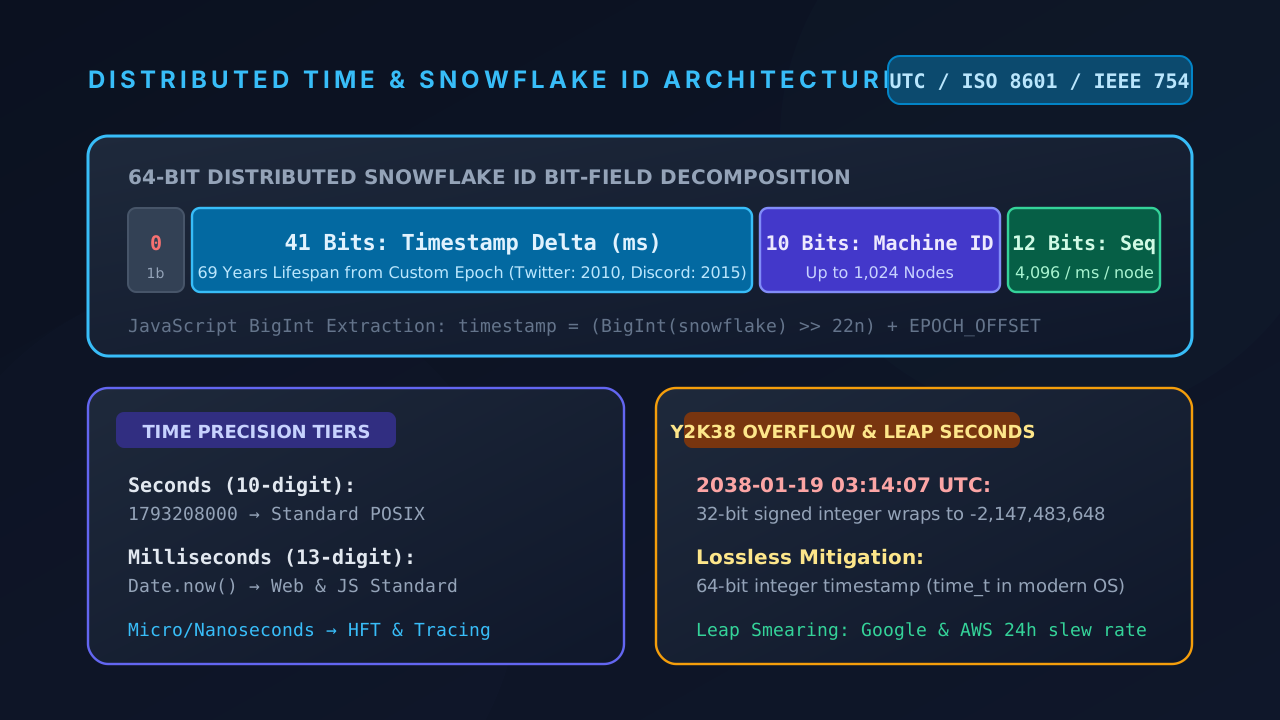
Traditional auto-incrementing database primary keys fail in sharded, multi-master database clusters because they create centralized serialization bottlenecks and leak transactional volume metrics to competitors.
To solve this, modern distributed systems (Twitter, Discord, Instagram, Bluesky) utilize 64-bit Snowflake IDs. These identifiers are roughly time-ordered, globally unique without inter-node coordination, and fit within an unsigned 64-bit integer.
The Bitfield Blueprint
A standard 64-bit Snowflake ID decomposes into four distinct bit ranges:
- Sign Bit (1 bit): Set to
0to keep the integer positive across languages with signed integer primitives (Java, Go, C#). - Timestamp Delta (41 bits): Milliseconds elapsed since an organization-specific custom epoch. 41 bits provide a temporal lifespan of:
(2⁴¹ - 1) / (1000 × 60 × 60 × 24 × 365.25) ≈ 69.73 years - Machine / Datacenter Identifier (10 bits): Allows up to 2¹⁰ = 1,024 independent worker nodes or container instances across datacenters without collision.
- Sequence Number (12 bits): Generates up to 2¹² = 4,096 unique IDs per millisecond per individual machine node, translating to a per-node throughput of over 4 million IDs per second.
// High-precision Snowflake timestamp extraction without IEEE 754 precision loss
function extractSnowflakeTimestamp(snowflakeId, customEpoch = 1420070400000n) {
  // Always use BigInt: numbers exceeding 2^53 - 1 corrupt in standard JavaScript
  const id = BigInt(snowflakeId);
  const timestampDelta = id >> 22n;
  const unixEpochMs = timestampDelta + customEpoch;
  return new Date(Number(unixEpochMs));
}

// Example: Discord Snowflake ID
const discordEpoch = 1420070400000n; // 2015-01-01T00:00:00.000Z
const messageId = "1284567890123456789";
const messageCreatedAt = extractSnowflakeTimestamp(messageId, discordEpoch);
console.log(messageCreatedAt.toISOString());
The Year 2038 Problem (Y2K38) & Integer Wraparound
The Year 2038 Problem arises from legacy 32-bit systems representing time as a signed 32-bit integer (time_t in C/C++).
- Maximum Representable Value: 2³¹ - 1 = 2,147,483,647 seconds.
- Critical Moment:
2038-01-19T03:14:07Z UTC. - Failure Mode: On the subsequent second, the binary value wraps from
0x7FFFFFFFto0x80000000(-2,147,483,648), resetting system time to1901-12-13T20:45:52Z UTC.
Modern distributed platforms enforce 64-bit signed integers (int64), pushing the temporal overflow boundary to: 2⁶³ - 1 ≈ 9.22 × 10¹⁸ seconds ≈ 292 billion years
NTP Synchronization, Leap Seconds & Leap Smearing
Because physical hardware clocks drift due to thermal fluctuations and quartz frequency variance, distributed systems employ the Network Time Protocol (NTP) to align system clocks against Stratum-1 atomic standards.
However, standard POSIX time assumes every day has exactly 86,400 seconds. When the International Earth Rotation and Reference Systems Service (IERS) schedules a leap second:
- Stepping (Standard NTP): The operating system repeats
23:59:59or jumps backward by 1 second, causing non-monotonic clock jumps that can crash transactional ledgers or trigger database deadlocks. - Leap Smearing (Google / AWS / Cloudflare Standard): Systems linearly slow down (or speed up) system clocks by a minute fraction (±11.57 ppm) across a 24-hour window, preserving monotonicity without abrupt time resets.
Epoch Converter & Unix Time Conversion Cheat Sheet
When developers search for an epoch converter, epoch time converter, or unix epoch converter, they usually need to convert between raw numeric timestamps and human-readable UTC or local dates. Here are quick, zero-dependency conversion snippets across common programming environments:
// JavaScript / TypeScript: Convert Epoch to Human Date
const epochSeconds = 1740000000;
const humanDate = new Date(epochSeconds * 1000).toISOString(); // "2025-02-19T21:20:00.000Z"

// Human Date to Epoch Seconds
const nowEpoch = Math.floor(Date.now() / 1000);
# Python 3: Unix Epoch Converter
from datetime import datetime, timezone
# Epoch to Human Date
dt = datetime.fromtimestamp(1740000000, tz=timezone.utc)
print(dt.strftime("%Y-%m-%d %H:%M:%S UTC"))
# Current Epoch Timestamp
current_epoch = int(datetime.now(tz=timezone.utc).timestamp())// Go: Unix Timestamp to Date
package main
import (
"fmt"
"time"
)
func main() {
tm := time.Unix(1740000000, 0).UTC()
fmt.Println(tm.Format(time.RFC3339))
}# Bash / Linux Terminal: Date to Epoch and Epoch to Date
date -d @1740000000 -u +"%Y-%m-%d %H:%M:%S UTC"
date +%s # Get current Unix timestampFor live interactive conversions with zero server uploads and sub-millisecond precision, use the in-browser Unix Timestamp & Epoch Converter.
Batch Epoch & CSV Log Conversion
In large-scale data engineering and observability pipelines (Elasticsearch, OpenSearch, ClickHouse, Datadog), logs frequently dump millions of events with raw Unix epoch integer timestamps (seconds or milliseconds) across massive CSV tables.
Manually converting individual epoch integers using command-line date -d @... or spreadsheet macros is slow and prone to timezone drift errors.
Using the DevOmniTools Unix Timestamp Converter, developers can convert batch lists of epoch values or paste CSV records directly into client-side browser memory:
- Automatic Multi-Unit Detection: Instantly differentiates 10-digit POSIX seconds (
1740000000), 13-digit milliseconds (1740000000000), and 16-digit microseconds. - Zero Data Leakage: Parsing and ISO-8601 string formatting execute 100% locally in browser RAM without uploading proprietary logs or user session telemetry to remote cloud servers.
- Custom Epoch Offset Support: Convert Discord, Twitter, and Mastodon Snowflake IDs into human-readable timestamps with 1-click presets.
FAQ
What is the Unix Epoch and why does it start on January 1, 1970?
The Unix Epoch is an arbitrary temporal origin chosen by Dennis Ritchie and Ken Thompson during the early development of Unix. Standardized in POSIX (IEEE Std 1003.1), it represents 1970-01-01T00:00:00Z UTC, serving as the foundational reference point for system time across modern computing.
How do Discord and Twitter Snowflake IDs extract timestamps?
Snowflake IDs use a 64-bit integer bitfield. The upper 41 bits represent milliseconds elapsed since a custom epoch (Twitter: 2010-11-04T01:42:54.657Z; Discord: 2015-01-01T00:00:00.000Z). Shifting right by 22 bits and adding the custom epoch offset derives the exact UTC timestamp.
How does the Year 2038 (Y2K38) overflow occur?
Systems storing Unix time in a 32-bit signed integer will overflow on January 19, 2038 at 03:14:07 UTC when the value exceeds 2,147,483,647. The sign bit flips, wrapping the clock back to December 13, 1901. Modern 64-bit architectures mitigate this completely.